Restore Chewing
A bridge can replace missing chewing surfaces and improve function.

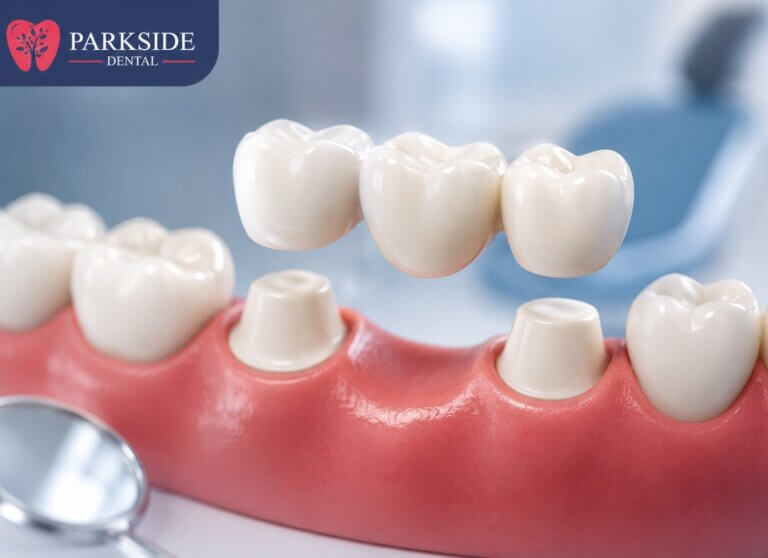
Dental bridges can replace one or more missing teeth and restore chewing function without requiring a removable denture. At ParkSide Dental in Brooklyn, we provide dental bridge treatment for patients with or without dental insurance, with insurance assistance and self-pay options available.
A dental bridge can replace one or more missing teeth using neighboring teeth or dental implants for support. ParkSide Dental provides traditional, cantilever, Maryland and implant-supported bridge options in Brooklyn with Dr. Anton Moskalenko, DDS.
Our office is located at 325 Ocean Ave, Brooklyn, NY 11225, near Prospect Park and Prospect Lefferts Gardens. English, Spanish, Russian and Ukrainian are spoken.
A dental bridge is a fixed tooth-replacement option used to fill a gap left by one or more missing teeth. Depending on the case, the bridge may be supported by natural teeth with crowns, bonded to adjacent teeth, or supported by dental implants.
The best option depends on the condition of nearby teeth, the number and location of missing teeth, bite forces, available bone, cosmetic goals and whether the patient wants implant surgery.
A fixed restoration used to replace one or more missing teeth.
A dental bridge uses one or more artificial teeth, called pontics, to fill a space created by missing teeth. The restoration is supported by natural teeth, bonded retainers or dental implants depending on the bridge design.
Unlike a removable partial denture, a fixed dental bridge is designed to stay in place and is not removed by the patient for routine cleaning.
Replacing missing teeth can improve both function and appearance.
A bridge can replace missing chewing surfaces and improve function.
Tooth-colored bridge materials can help fill visible gaps.
Replacing missing teeth can help distribute biting forces more evenly.
A bridge may help reduce shifting of neighboring teeth into an open space.
The restoration remains in place rather than being removed daily.
Selected patients may prefer a traditional bridge when implant treatment is not desired or appropriate.
Bridge design depends on the missing-tooth area and available support.
Uses crowns on teeth next to the gap to support one or more replacement teeth.
Supported from one side of the missing-tooth space in selected situations.
A resin-bonded bridge that uses wings bonded to the back of adjacent teeth.
Uses dental implants rather than natural teeth as support for multiple replacement teeth.
Bridge candidacy depends on the missing teeth and the condition of the supporting structures.
A bridge may be considered for patients missing one or more teeth who want a fixed replacement. For a traditional bridge, the neighboring teeth must be evaluated to determine whether they can support crowns and the forces placed on the bridge.
Implant-supported bridges require evaluation of bone, gum health and implant positioning.
The process varies depending on whether the bridge is tooth-supported or implant-supported.
The dentist evaluates the missing-tooth area, neighboring teeth, gums and bite.
The bridge type and supporting teeth or implants are selected based on the clinical findings.
For traditional bridges, supporting teeth are prepared for crowns. Implant-supported bridges require implant planning and placement.
Records are taken so the bridge can be designed for fit, bite and appearance.
A temporary restoration may be used in selected tooth-supported bridge cases.
The bridge is checked and secured after fit, bite and appearance are evaluated.
“Choosing between a bridge and an implant is not only about replacing the missing tooth. We also look at the neighboring teeth, the bite, available bone and what will provide the most predictable restoration for that patient.”— Dr. Anton Moskalenko, DDS
Both treatments can replace missing teeth, but they use different types of support.
Uses neighboring teeth for support and typically does not require implant surgery.
Replaces a missing tooth root with an implant that supports a crown or larger restoration.
Uses strategically placed implants to support multiple replacement teeth without relying on natural teeth for support.
The answer depends on adjacent teeth, bone, gum health, number of missing teeth, treatment goals, cost and patient preference.
Learn more about dental implants in Brooklyn and bone grafting for dental implants.
Traditional bridges commonly use crowns on neighboring teeth for support.
In a traditional bridge, crowns are placed over the supporting teeth and connected to the replacement tooth or teeth between them. The condition of those supporting teeth is therefore an important part of bridge planning.
Learn more about dental crowns in Brooklyn.
Dental bridge treatment at ParkSide Dental may range from $1,500 to $5,000.
The final cost depends on the bridge type, number of replacement teeth, restorative materials, condition of supporting teeth, whether dental implants are used and the overall complexity of treatment.
With insurance: Dental insurance may cover part of a medically necessary bridge. Coverage depends on the plan, deductible, annual maximum, network benefits, missing-tooth clauses, replacement-frequency rules and other limitations.
Without insurance: Self-pay options are available, with treatment costs generally ranging from $1,500-$5,000 depending on the individual treatment plan.
Cleaning around and underneath a bridge is important for the supporting teeth and gums.
Follow your dentist’s instructions while the teeth and gums adjust to the restoration.
Floss threaders, interdental cleaners or other tools may be recommended to clean beneath the replacement teeth.
Decay or gum disease around supporting teeth can affect the long-term stability of the bridge.
Routine examinations allow the dentist to monitor the bridge, supporting teeth, bite and gums.
Bridge longevity depends on the supporting teeth or implants, bite, oral hygiene and restorative materials.
There is no guaranteed lifespan for a dental bridge. Good home care, regular dental visits and protection from excessive biting forces can help support long-term function.
A bridge should be evaluated if it becomes loose, painful, difficult to clean or if a supporting tooth develops sensitivity or decay.
Brooklyn is our primary location and focus. ParkSide Dental is located at 325 Ocean Ave, Brooklyn, NY 11225, near Prospect Park and Prospect Lefferts Gardens. We also see patients from Flatbush, Crown Heights, Kensington, Ditmas Park, Windsor Terrace and surrounding Brooklyn neighborhoods.
Languages spoken: English, Spanish, Russian and Ukrainian.
Cost, insurance, implants and common questions patients ask about replacing missing teeth.
Dental bridge treatment at ParkSide Dental may range from $1,500 to $5,000 depending on bridge type, materials, number of teeth being replaced and treatment complexity.
Many dental plans may cover a portion of medically necessary bridge treatment, but benefits and limitations vary by plan.
Self-pay bridge treatment may range from $1,500 to $5,000 depending on the individual treatment plan.
Neither option is universally better. The choice depends on adjacent teeth, bone, gum health, number of missing teeth, cost, treatment goals and patient preference.
A fixed dental bridge is designed to remain in place. It is different from a removable partial denture.
Yes. Bridge design depends on the location and number of missing teeth and the available support from teeth or dental implants.
Traditional bridges generally require preparation of the supporting teeth for crowns. Other designs, such as selected Maryland bridges or implant-supported bridges, use different forms of support.
Your dentist may recommend floss threaders, interdental brushes or other cleaning tools to reach beneath the replacement teeth and around supporting teeth.
The artificial replacement tooth cannot decay, but the natural supporting teeth can develop decay around the crown margins.
Contact the dental office for evaluation. A loose bridge can be related to cement failure, supporting-tooth problems or other restorative issues.
An examination can help determine which missing-tooth replacement option fits your situation.
Call (718) 462-7436 and tell our team how many teeth you are missing or whether you are replacing an existing bridge.
Use our online appointment request and briefly describe the missing-tooth area.
ParkSide Dental is located at 325 Ocean Ave, Brooklyn, NY 11225, near Prospect Park.
Dr. Anton Moskalenko, DDS can evaluate the supporting teeth, bite and missing-tooth area and explain bridge and implant options.
Restorative and missing-tooth replacement care at ParkSide Dental in Brooklyn.
Dr. Anton Moskalenko, DDS provides comprehensive dental care at ParkSide Dental and evaluates patients considering traditional and implant-supported dental bridges.
Treatment planning is based on the condition of adjacent teeth, bite, available bone, number of missing teeth, restorative goals and patient preferences.

If you are missing one or more teeth, an examination can help determine whether a traditional bridge, implant-supported bridge, dental implant or another tooth-replacement option is appropriate.
ParkSide Dental
325 Ocean Ave
Brooklyn, NY 11225
English • Spanish • Russian • Ukrainian spoken
We Are Right Around The Corner When You Need Us