Lingering Hot or Cold Sensitivity
Pain that continues after the trigger is removed can suggest deeper pulp inflammation.

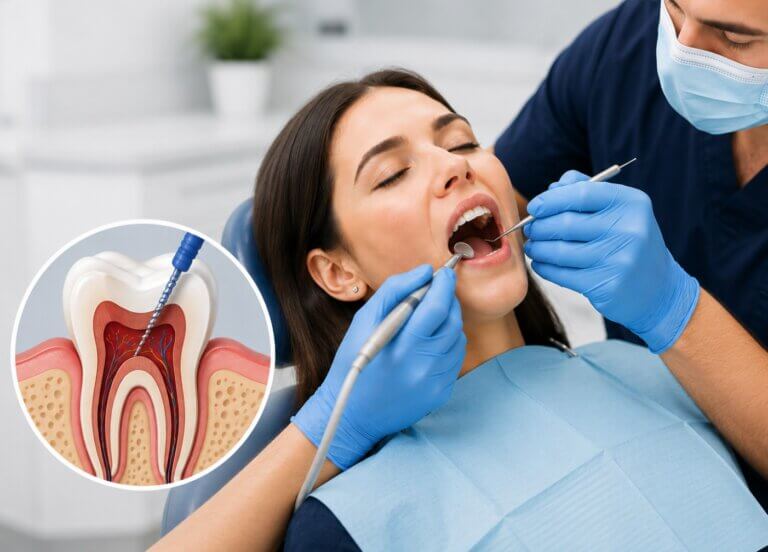
Severe tooth pain, lingering sensitivity, deep decay or infection inside a tooth may mean the dental pulp is damaged. ParkSide Dental provides root canal evaluation and treatment in Brooklyn with Dr. Anton Moskalenko, DDS, with care focused on relieving pain and preserving the natural tooth when appropriate.
Our office is located at 325 Ocean Ave, Brooklyn, NY 11225, near Prospect Park and Prospect Lefferts Gardens. English, Spanish, Russian and Ukrainian are spoken.
A root canal treats inflammation or infection inside the tooth by removing damaged pulp tissue, cleaning and shaping the canals, and sealing the inside of the tooth. The goal is to save a tooth that might otherwise need extraction.
Root canal treatment is not needed for every painful tooth. A dental examination and X-rays help determine whether the pulp is irreversibly inflamed or infected and whether the tooth can be restored.
Symptoms can overlap with other dental problems, so diagnosis matters.
Pain that continues after the trigger is removed can suggest deeper pulp inflammation.
A tooth that aches without eating or drinking may need prompt evaluation.
Pressure sensitivity can occur when tissues around the tooth root are irritated.
Swelling, a gum bump, drainage or a bad taste may indicate infection around the tooth.
A cavity or restoration close to the pulp can increase the risk of pulp damage.
A crack or injury may damage the pulp even when the tooth is still present.
Root canal treatment addresses disease or damage inside the tooth.
When the pulp is too inflamed to recover predictably, root canal therapy may allow the tooth to be retained.
Bacteria can enter the pulp through deep decay, cracks or trauma and cause infection.
Infection can spread from the pulp into tissues around the root and form an abscess.
A tooth injured by impact or fracture may later require root canal treatment.
Pulpitis is one of the most common reasons a tooth may need root canal therapy.
Pulpitis means inflammation of the dental pulp. Reversible pulpitis may improve when the source of irritation is treated, while irreversible pulpitis generally requires treatment of the pulp itself if the tooth is to be saved.
Learn more about pulpitis treatment in Brooklyn.
The exact sequence varies by tooth anatomy and clinical findings.
The dentist evaluates symptoms, tooth structure, the surrounding bone and the likely condition of the pulp.
The treatment area is numbed before the procedure begins.
An opening is made in the tooth to reach the pulp chamber and root canals.
Damaged pulp tissue is removed and the canals are cleaned and shaped.
The prepared canals are filled with a root canal material and sealed.
A filling, crown or other restoration may be needed to protect the tooth after treatment.
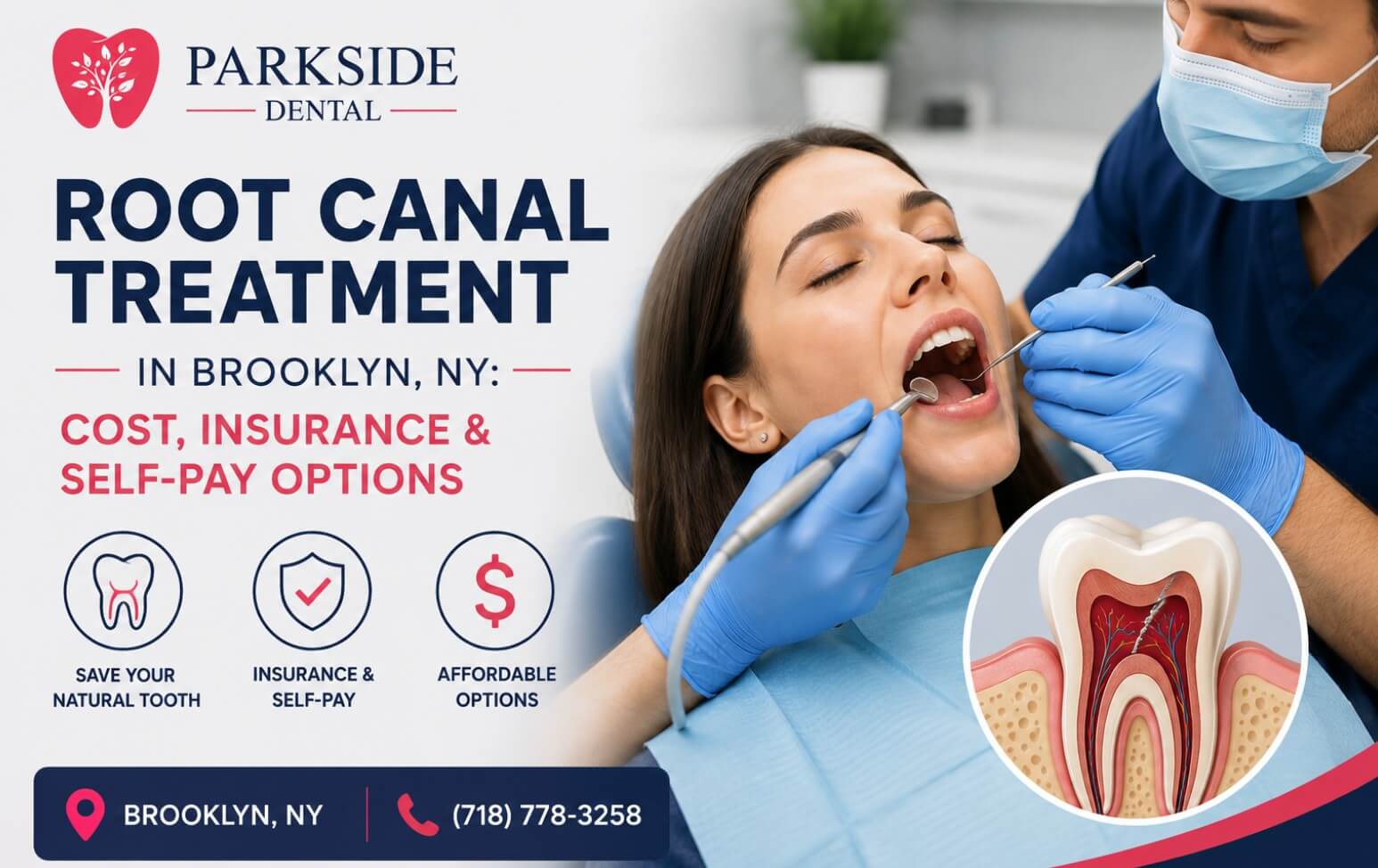
Root canal treatment at ParkSide Dental in Brooklyn, NY, with insurance and self-pay options available.
“The goal of root canal treatment is to remove the source of pain or infection while preserving a tooth that can still function well after it is properly restored.”Suggested quote for approval — Dr. Anton Moskalenko, DDS
Modern root canal treatment is performed with local anesthesia.
The tooth and surrounding area are numbed before treatment. Patients may feel pressure or movement during the procedure, but the goal is to keep the treatment comfortable.
Temporary tenderness after a root canal can occur, especially if the tooth was painful or inflamed before treatment. Persistent or worsening pain should be discussed with the dentist.
ParkSide Dental publishes the following self-pay root canal price ranges:
$100
$500-$1,000
$700-$1,200
$800-$1,500
With insurance: Dental insurance may cover part of root canal treatment depending on the plan, deductible, annual maximum, network status and coinsurance.
Without insurance: Patients can use ParkSide Dental’s published self-pay ranges and discuss available payment options with the office.
A crown or other final restoration may have a separate cost. See our Brooklyn dental pricing and self-pay guide.
Not every root-treated tooth is restored the same way.
A tooth may need a filling, crown or another restoration after root canal treatment depending on how much healthy tooth structure remains, where the tooth is located and how much chewing force it receives.
Back teeth often require stronger protection because they handle greater chewing forces. Dr. Moskalenko can explain the recommended restoration after evaluating the treated tooth.
Most patients can return to routine activities relatively quickly, but the tooth still needs protection while it heals and before the final restoration is complete.
Avoid chewing until normal sensation returns so you do not accidentally bite your cheek or tongue.
Softer foods may feel more comfortable at first, especially if the tooth is tender.
Avoid very hard chewing on the treated tooth until your dentist says the final restoration is ready for normal use.
Continue brushing and flossing unless your dentist gives you different instructions for the treated area.
When a tooth can be predictably restored, root canal treatment may preserve the natural tooth.
Removes damaged pulp while keeping the tooth in place so it can be restored and used.
Removes the entire tooth when it cannot be predictably saved or restored.
If extraction becomes necessary, review tooth extraction and wisdom tooth removal in Brooklyn. If the tooth is lost, dental implants in Brooklyn may be one replacement option.
Contact a dentist promptly for severe or worsening tooth pain, swelling, fever, drainage, a bad taste, pain that wakes you at night, or a tooth that is very painful to bite on.
If swelling affects breathing or swallowing, or symptoms are severe and rapidly progressing, seek urgent medical attention.
Brooklyn is our primary location and focus. ParkSide Dental is located at 325 Ocean Ave, Brooklyn, NY 11225, near Prospect Park and Prospect Lefferts Gardens. We also see patients from Flatbush, Crown Heights, Kensington, Ditmas Park, Windsor Terrace and surrounding Brooklyn neighborhoods.
Languages spoken: English, Spanish, Russian and Ukrainian.
Cost, insurance, pain, recovery and questions patients commonly ask before root canal therapy.
ParkSide Dental currently lists front-tooth root canals at $500-$1,000, premolars at $700-$1,200 and molars at $800-$1,500.
Many dental plans provide some endodontic benefits, but coverage varies by deductible, annual maximum, network status and coinsurance. The office can review available insurance information.
Self-pay cost depends on the tooth. ParkSide Dental publishes ranges of $500-$1,000 for front teeth, $700-$1,200 for premolars and $800-$1,500 for molars.
Local anesthesia is used to numb the treatment area. Some pressure may be felt during treatment, and temporary tenderness can occur afterward.
Appointment time varies based on the tooth, number of canals, anatomy, infection and whether additional treatment is needed. Some cases may require more than one visit.
If only local anesthesia is used and you otherwise feel well, many patients can drive afterward. Follow any specific instructions provided by your dentist.
Wait until numbness has worn off before chewing. Softer foods may be more comfortable initially, and avoid heavy chewing on the treated tooth until it is appropriately restored.
No. The final restoration depends on the tooth, how much healthy structure remains and where the tooth is located. Some teeth may need a filling while others benefit from a crown.
Antibiotics do not remove damaged pulp tissue inside the tooth. They may be prescribed in selected cases if infection has spread, but the underlying dental problem still needs definitive treatment.
Infection or inflammation can progress and may spread into tissues around the tooth. Pain may also change or temporarily improve even though the underlying problem is not resolved.
Getting the tooth evaluated is the first step.
Call (718) 462-7436 and tell our team you have tooth pain, sensitivity, swelling or were told you may need a root canal.
Use our online appointment request and briefly describe your symptoms.
ParkSide Dental is located at 325 Ocean Ave, Brooklyn, NY 11225, near Prospect Park.
Dr. Anton Moskalenko, DDS can examine the tooth, review X-rays and explain whether root canal treatment or another option is appropriate.
What to bring: Bring your insurance information, medication list and any recent dental X-rays or records if available.
Root canal and comprehensive restorative dental care at ParkSide Dental in Brooklyn.
Dr. Anton Moskalenko, DDS provides comprehensive dental care at ParkSide Dental and evaluates patients with tooth pain, pulpitis, deep decay and other conditions that may require root canal therapy.
Treatment recommendations are based on whether the tooth can be predictably saved, how much healthy structure remains and what restoration will be needed afterward.

If you have severe tooth pain, lingering sensitivity, swelling or a tooth with deep decay, an examination can help determine whether root canal treatment can save the tooth.
ParkSide Dental
325 Ocean Ave
Brooklyn, NY 11225
English • Spanish • Russian • Ukrainian spoken
We Are Right Around The Corner When You Need Us